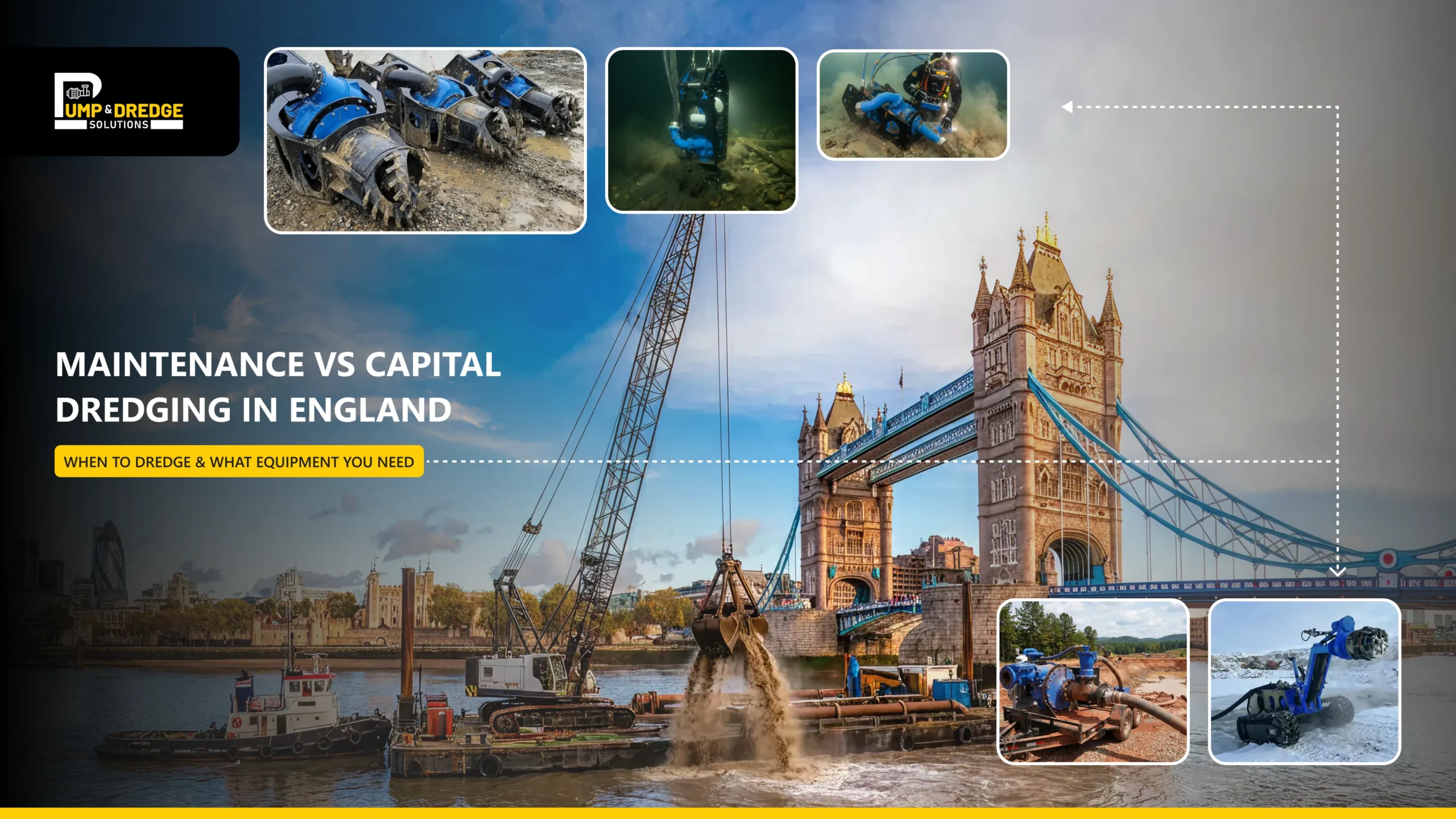

In England, the distinction between maintenance and capital dredging directly determines how a project is approved, how long it takes to deliver, and what equipment can be used on site.
Maintenance dredging is routine dredging performed to restore previously approved depths. It is typically cyclical, planned, and focused on removing naturally accumulated silt or sediment. Ports, marinas, canals, and flood-control channels rely on maintenance dredging to stay operational and compliant. From an execution standpoint, these projects favour efficient, repeatable setups using proven England dredging equipment that can mobilise quickly with minimal disruption.
Capital dredging, on the other hand, is undertaken to create new depths or significantly change existing ones. This includes harbour deepening, berth construction, widening navigation channels, or enabling passage for larger vessels. Capital projects are less frequent but far more complex. They require deeper project justification, more extensive surveys, longer approval cycles, and heavier-duty dredging systems.
For project owners and contractors, the risk lies in misclassification. Treating a capital dredging scope as maintenance can delay approvals. Treating maintenance work as a capital project can unnecessarily inflate costs. This is where early dredging project planning in England matters, and where experienced suppliers like Pump & Dredge Solutions add value by aligning dredge intent, regulatory requirements, and equipment choice from the start.
In the next section, we break down exactly when a project shifts from maintenance to capital dredging, using clear decision triggers relevant to English waterways and coastal works.
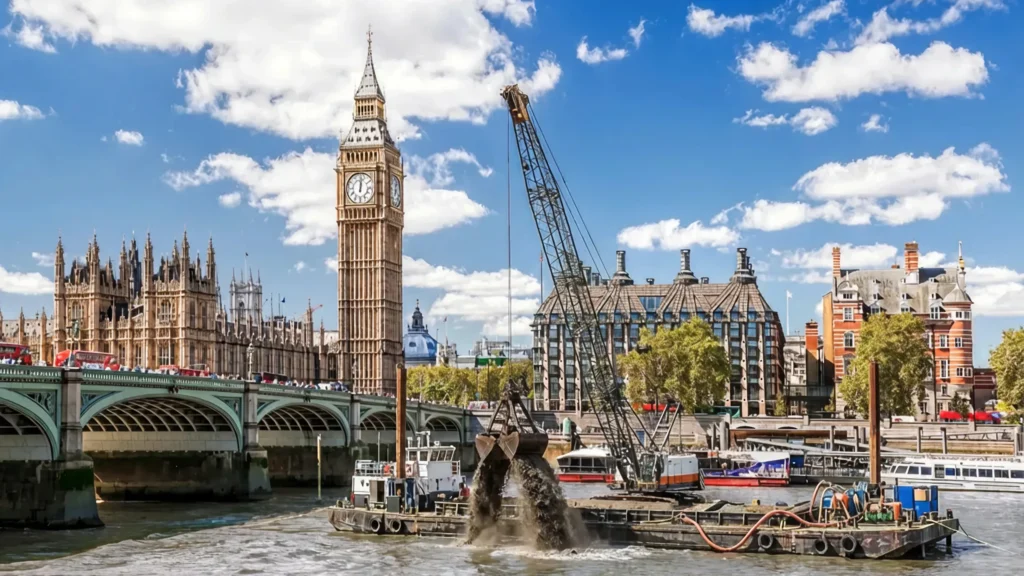
When does dredging shift from maintenance to capital? Key decision triggers in England
The line between maintenance and capital dredging in England is defined less by intent and more by impact. Project owners often assume that if dredging has happened before, it automatically qualifies as maintenance. In practice, regulators look at what is being changed, not just what is being removed.
A dredging project is typically treated as maintenance when it restores previously approved depths and footprints and when similar work has been carried out within an established cycle. This is common for marinas maintaining access channels, ports managing sedimentation, or river authorities keeping conveyance capacity unchanged. These projects are usually planned around operational continuity, making fast-deploying and reliable England dredging equipment critical.
A project moves into capital dredging territory when it alters the seabed beyond historical approvals. This includes deepening beyond prior limits, widening channels, creating new berths, or enabling different vessel classes. Even if dredging occurred years ago, long gaps or scope changes can trigger capital classification. Capital dredging also applies when works are tied to construction, redevelopment, or long-term capacity expansion. From a dredging project planning England perspective, three triggers almost always signal capital works:
- First, increasing depth or footprint beyond existing consent;
- Second, a lapse of many years since the last comparable dredge;
- Third, integration with new infrastructure or land reclamation.
Identifying this early avoids permitting delays and equipment mismatches. Pump & Dredge Solutions regularly supports clients at this decision stage, helping confirm project classification and ensuring that the selected dredging systems align with both regulatory expectations and site realities.
Next, we look at how this classification directly affects permitting, approvals, and timelines in England.
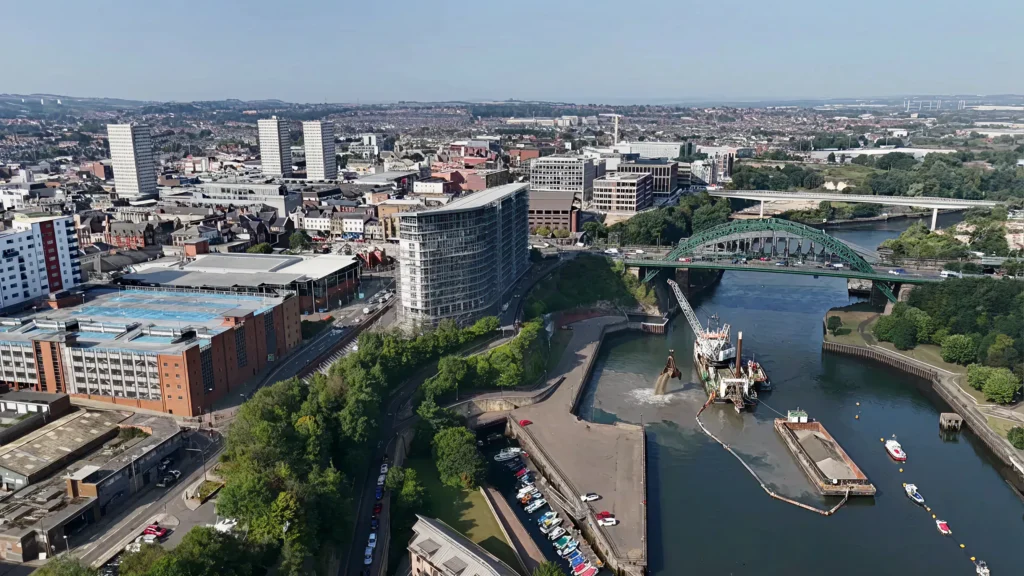
Permitting and approvals in England: how dredge type affects timelines and risk
Once a project is clearly defined as maintenance vs capital dredging, the approval pathway in England becomes far more predictable. Getting this step wrong is one of the most common causes of delay in dredging projects.
Maintenance dredging usually follows an established consent framework. Where depths, methods, and disposal locations remain unchanged, approvals can often be streamlined. Many ports and navigation authorities operate under standing permissions or long-term licences, allowing routine dredging to proceed with minimal lead time. For these projects, planning focuses on operational windows and on ensuring that the selected England dredging equipment meets existing environmental and safety requirements.
Capital dredging carries a higher regulatory burden. Projects that alter depth, footprint, or seabed conditions typically require a new Marine Management Organisation licence, along with environmental assessments and stakeholder consultation. Additional oversight may also involve the Environment Agency, local planning authorities, or harbour masters, depending on location and flood-risk implications. These approvals add months to schedules if not accounted for early in dredging project planning in England.
The key risk is underestimating consent scope. A project planned with maintenance assumptions but reviewed as capital can be paused mid-process, forcing redesign and reapplication. This is where early technical input matters. Pump & Dredge Solutions supports clients by aligning dredge method statements, equipment capability, and discharge planning with expected regulatory requirements, reducing approval friction.

With approvals understood, the next step is selecting the right dredging equipment for each dredge type and understanding why one setup rarely fits both.
Matching dredging equipment to dredge type — what actually works in England
Choosing the wrong equipment is one of the fastest ways to overrun a dredging budget. In England, where access constraints, environmental controls, and mobilisation costs are tightly managed, equipment selection must follow dredge classification, not the other way around.
For maintenance dredging, efficiency and repeatability matter most. These projects typically deal with fine sediments, moderate volumes, and predictable conditions. Compact cutter suction dredgers, excavator-mounted dredge pumps, and portable dewatering systems are commonly used because they can be deployed quickly and removed without long site disruption. Flexible discharge pipelines and layflat hoses are also preferred, particularly in canals, marinas, and river works where space is limited. This category of England dredging equipment supports routine programmes without locking operators into high capital costs.
Capital dredging requires a different approach. Larger volumes, deeper cuts, and longer discharge distances require higher-capacity cutter-suction dredgers, heavy-duty slurry pumps, booster stations, and barging support. These systems are designed to maintain production rates under higher head pressures and abrasive conditions. Capital projects often justify purpose-built setups or longer-term rentals due to the scale and duration involved.
There is also a growing middle ground. Remote-operated dredges and modular pump systems are increasingly used where access is restricted or where environmental sensitivity limits conventional plant. Pump & Dredge Solutions supplies and supports these specialised systems, helping contractors scale equipment precisely to project scope rather than overbuilding the solution.
With equipment matched to the dredge type, the next challenge is sizing and configuring the equipment correctly so that output, wear life, and compliance remain aligned throughout the project.
Sizing and configuring dredging equipment, where most projects gain or lose efficiency
Even with the correct dredge type selected, performance in England depends on how well the equipment is sized and configured for real site conditions. Undersized systems stall production. Oversized systems increase fuel use, wear, and mobilisation cost without delivering proportional gains.
For maintenance dredging, sizing is driven by sediment characteristics and campaign frequency. Fine silts and soft deposits require steady flow rather than extreme cutting power. Pump selection focuses on maintaining velocity through shorter discharge lines while minimising abrasion. In these cases, compact dredge pumps paired with flexible pipeline layouts perform well, particularly when access windows are tight. Choosing the right England dredging equipment here reduces downtime between repeat dredging cycles.
Capital dredging introduces more variables. Deeper cuts, longer discharge distances, and higher solids concentrations require careful pump head calculations, booster placement, and pipeline design. Projects often fail when discharge routing is treated as an afterthought. A correct configuration ensures that material reaches the disposal or reclamation site without blockages or excessive wear.
This is where early dredging project planning in England pays off. Pump & Dredge Solutions works with contractors to assess flow rates, solids loading, discharge length, and site constraints before equipment is mobilised. This approach reduces mid-project adjustments and keeps production targets realistic.
Next, we look at cost and lifecycle considerations, and how maintenance and capital dredging differ when viewed over multiple years rather than a single project window.
Cost and lifecycle thinking: looking beyond a single dredging campaign
In England, dredging decisions are rarely one-off events. When comparing maintenance vs capital dredging, the real cost difference becomes clear only when projects are evaluated over multiple years.
Maintenance dredging spreads cost across repeated, predictable campaigns. While individual operations are smaller, they occur more frequently. This makes operating efficiency, mobilisation speed, and equipment reliability critical. Well-matched England dredging equipment reduces wear, fuel consumption, and labour time, lowering the total cost of ownership. For ports and waterways with consistent sedimentation, this steady-state approach often delivers the lowest long-term risk.
Capital dredging carries a higher upfront cost but can reset maintenance requirements. Deepening a channel or basin may reduce the frequency of future dredging in the short to medium term. However, capital projects also tend to increase sedimentation rates over time due to altered hydrodynamics. This means that capital dredging should never be assessed in isolation; it must be modelled alongside future maintenance demand.
From a dredging project planning England perspective, lifecycle analysis helps justify equipment choices. Short-term hiring may suit capital works, while ongoing maintenance often supports a rental-plus-service or mixed-ownership model. Pump & Dredge Solutions advises clients on these decisions by comparing capital outlay, rental duration, servicing needs, and redeployment potential.
With cost understood, the next section addresses environmental and operational constraints that influence how and when dredging can proceed in English waterways.
Environmental and operational constraints: planning dredging the right way in England
Environmental controls are a defining factor in dredging project planning in England, and they influence both scheduling and equipment choice far more than many project owners expect.
For maintenance dredging, constraints are often known in advance. Established dredge windows, turbidity limits, and disposal routes are typically built into long-standing licences. The operational focus is on staying within those limits while maintaining productivity. Low-turbidity dredge pumps, controlled flow rates, and shorter discharge runs help operators meet environmental conditions without slowing output. Selecting the right England dredging equipment here reduces compliance risk during routine operations.
Capital dredging faces stricter scrutiny. New seabed disturbance can affect habitats, sediment transport, and water quality. As a result, projects may be limited to specific seasons, require additional monitoring, or impose restrictions on working hours. Equipment configuration becomes part of the mitigation strategy. Using precise cutting systems, controlled pumping rates, and modular discharge layouts can significantly reduce environmental impact and support approval conditions.
Operational constraints also matter. Tidal windows, restricted access, urban proximity, and shared waterways all shape how dredging is executed. Pump & Dredge Solutions works with contractors to adapt dredging systems to these realities, ensuring equipment selection supports both regulatory compliance and day-to-day site efficiency.
Next, we examine procurement strategy, considering when it makes sense to rent, buy, or combine dredging equipment for projects in England.
Procurement strategy: rent, buy, or hybrid equipment models in England
Procurement decisions play a major role in how efficiently a dredging project is delivered. In England, where project scopes vary widely and regulatory timelines can shift, flexibility often matters more than ownership.
For maintenance dredging, rental or hybrid models are frequently the most practical. These projects are cyclical, predictable, and time-bound. Renting England dredging equipment allows operators to match pump capacity, hose length, and dredge configuration to each campaign without carrying idle assets year-round. A hybrid approach, owning core components while renting boosters, hoses, or support systems, offers control without overcommitting capital.
Capital dredging projects tend to justify longer rental periods or project-specific packages. The scale and duration make outright purchase less attractive unless the equipment will be redeployed across multiple sites. Procurement here is less about the lowest upfront cost and more about guaranteed performance, technical support, and mobilisation speed.
From England’s perspective on dredging project planning, procurement should be aligned with permitting certainty. Locking in ownership before approvals are secured increases risk. Pump & Dredge Solutions supports clients with phased procurement, allowing equipment selection and commitment to evolve as project scope and consent clarity improve.
Next, we look at how Pump & Dredge Solutions supports dredging projects in England, from early planning through execution.
How Pump & Dredge Solutions supports dredging projects in England — from planning to execution
Successful dredging in England depends on decisions made long before equipment arrives on site. This is where Pump & Dredge Solutions positions itself not just as an equipment supplier, but as a technical partner throughout the project lifecycle.
Support typically begins during early dredging project planning in England stages. This includes reviewing project intent, confirming whether works fall under maintenance or capital dredging, and advising on likely regulatory expectations. Early clarity at this stage reduces redesign, resubmissions, and mobilisation delays later on.
Once the scope is defined, Pump & Dredge Solutions assists with equipment selection and configuration, ensuring pumps, dredges, pipelines, and dewatering systems are matched to sediment type, discharge distance, and access constraints. This practical alignment helps contractors avoid oversizing or underperforming systems, a common issue in both maintenance and capital projects.
During execution, the focus shifts to reliability and response. On-site support, spare availability, and configuration adjustments keep production steady even when conditions change. For clients working with rented England dredging equipment, this ongoing technical backing is often the difference between meeting programme targets and falling behind.
Practical takeaways for dredging projects in England: making the right call early
The difference between successful and delayed dredging projects in England is rarely the dredge itself. It is the quality of decisions made during early planning.
Understanding maintenance vs capital dredging is the first and most important step. This classification shapes permitting routes, project timelines, and the type of England dredging equipment required. Misalignment here leads to unnecessary approvals, equipment changes, and cost escalation.
Effective dredging project planning in England means looking beyond immediate excavation needs. It requires considering lifecycle cost, environmental constraints, access limitations, and future maintenance implications. Equipment should be selected to match real-world site conditions, not to meet assumed production targets.
Working with an experienced partner reduces these risks. Pump & Dredge Solutions supports clients from early scoping through execution, ensuring dredging systems are practical, compliant, and commercially sound.If you are planning maintenance or capital dredging works in England, speak with Pump & Dredge Solutions for a site-specific equipment assessment and project review. Early guidance can save months in approvals and significant cost during execution.